
Why CI/CD matters now
Most business platforms are no longer static projects. A website may need a pricing update, a portal may need a new report, an app may need a security patch, and a checkout flow may need a quick fix before a campaign goes live.
CI/CD turns that constant change into a managed process. Instead of asking who uploaded what, which command was missed or whether the server was updated properly, the team follows one visible release path with checks built into it.
CI/CD in simple words
Continuous Integration means developers bring their code together often, while automated checks confirm that the new work has not broken the existing project.
Continuous Delivery or Deployment means the approved code can move toward staging or production through a repeatable workflow, instead of waiting for someone to perform every release step by hand.
The familiar problem: It works on my machine
Every team has seen this situation: a change looks fine during development, but behaves differently once it reaches the live environment. The issue is usually not the idea itself, but the gap between how the project is checked locally and how it runs in production.
A CI/CD pipeline narrows that gap by rebuilding, checking and preparing the project through the same controlled workflow each time. It brings consistency to the release process, so small environment differences are less likely to surprise the team after deployment.
What a pipeline handles
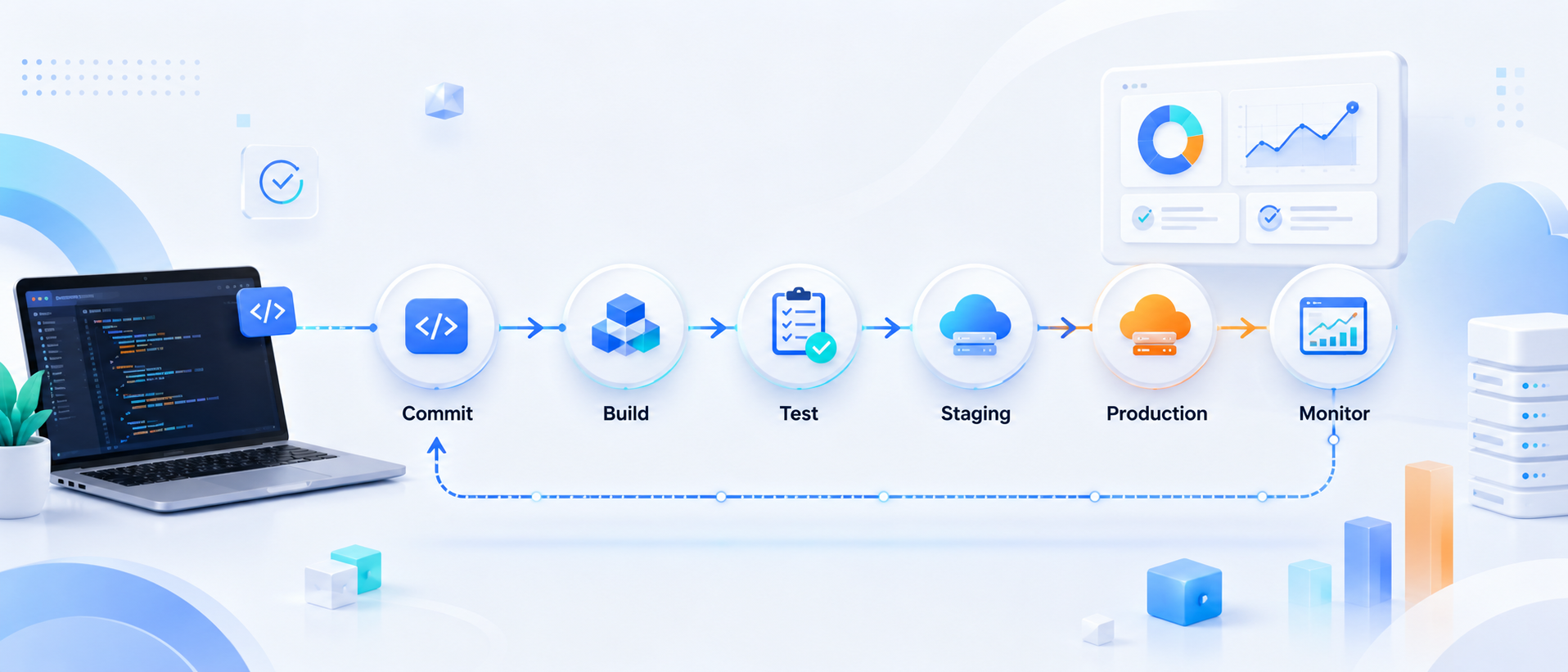
A pipeline can pull the latest code, install dependencies, build the frontend, run backend checks, prepare environment files, apply deployment commands and notify the team when something fails.
For mature projects, it can also include staging approvals, database migration checks, release notes, rollback steps and post-release monitoring. The value is simple: the same important steps run every time, even when the update is small or urgent.
- ✓ Clean build before release
- ✓ Automated tests and checks
- ✓ Package and dependency review
- ✓ Staging approval before production
- ✓ Rollback plan for risky updates
- ✓ Logs and monitoring after launch
What changes for the business
The main benefit is not only speed. The bigger benefit is confidence. Teams know what was released, when it was released, who approved it and where the process failed if something went wrong.
That clarity helps developers, QA, project managers and operations teams work from the same status instead of depending on chat messages, personal notes or server-side assumptions.
Security checks start earlier
Modern applications depend on packages, APIs, keys, cloud tools and third-party services. A pipeline can add early checks for vulnerable dependencies, exposed secrets, failed builds and risky configuration changes.
This does not replace a full security review, but it gives the team an early warning layer. Problems are much easier to fix before they reach production.
When should a business invest in CI/CD?
CI/CD is worth considering when more than one developer works on the project, updates happen every week, deployments feel tense, or downtime can affect leads, orders, bookings, subscriptions, users or internal operations.
It is especially helpful for SaaS products, e-commerce stores, CRMs, dashboards, mobile apps, Laravel and React applications, API-based systems and any platform that keeps growing after launch.
Final thought
CI/CD is not just a developer convenience. It is a safer release habit for businesses that depend on software. It gives every update a route, every failure a visible point, and every release a cleaner history.
In 2026, the strongest digital products will not be the ones that never change. They will be the ones that can improve regularly without turning every update into a risk.
When software supports sales, operations or customer experience, release quality matters. CI/CD brings order, traceability and repeatable checks to every update.