
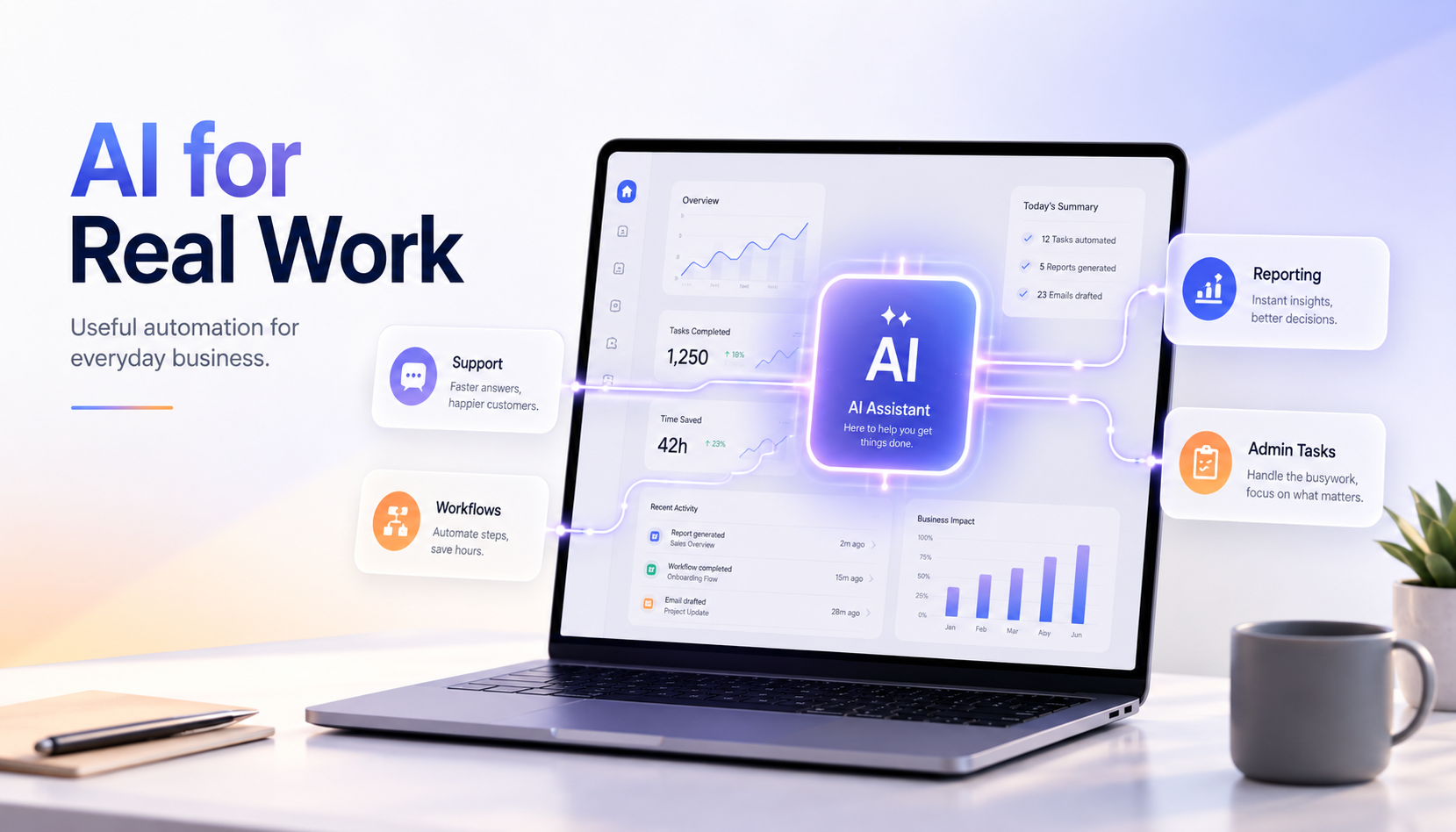
AI Has Stopped Being a Party Trick
For a long time, AI sounded like something companies mentioned because it looked impressive in a pitch deck. Everyone nodded, a few people said "innovation," and then the team went back to answering the same emails by hand.
That phase is ending. Businesses are now using AI in smaller, quieter places where work actually gets done: sorting inquiries, drafting replies, summarizing calls, spotting patterns in reports and helping teams move through repetitive tasks a little faster.
This is the part many people miss. AI does not need to feel dramatic to be valuable. Sometimes the best use of AI is simply removing the boring five-minute task that happens forty times a week.
That may not sound like science fiction. Good. Real business improvement usually looks less like a movie scene and more like someone finally getting their Friday afternoon back.
Do Not Start with the Tool
A common mistake is starting the conversation with a tool name. Someone hears about a new AI platform, watches two videos, and suddenly the business "needs AI". That is how teams end up buying software before they understand the problem.
A better starting point is embarrassingly simple: look at the work your team repeats every week. Which questions are customers asking again and again? Which reports take too long to prepare? Which leads are getting missed because nobody replied quickly enough? Which data lives in three different places and annoys everyone equally?
Those are the useful clues. If a process is slow, repetitive, rule-heavy, or dependent on quick sorting, AI may help. If the problem is unclear ownership, poor service planning, or messy internal communication, AI will not magically tidy the room. It will only add another chair to the mess.
Start with the bottleneck. Then decide whether AI, automation, a better form, a cleaner dashboard, or a simple workflow change is the right fix.
A Chatbot Needs a Job Description
Website chatbots have earned their bad reputation. Too many appear instantly, interrupt the visitor and then fail at the first serious question. It is like hiring a receptionist who only knows how to say hello.
The issue is rarely the chatbot itself. The issue is planning. Before adding one to a website, decide what it is responsible for. Should it answer service questions, collect project details, route support requests, help visitors compare packages, book a consultation, or capture leads after business hours?
Once the role is clear, the experience becomes much better. The chatbot can guide users instead of guessing. It can ask the right questions, pass useful information to the team, and reduce the back-and-forth that usually happens before a proper conversation even begins.
A chatbot should not be decoration. It should either save time, improve response speed, or help the visitor move one step closer to a decision. If it does none of those things, it is just a pop-up wearing a name badge.
Prompt Writing Is Just Clear Communication
People have made prompt writing sound more mysterious than it needs to be. At its core, a prompt is an instruction. If the instruction is vague, the result will be vague. That is not an AI problem; it is a planning problem.
Ask a developer to "fix the website" and they will ask what is broken. Ask a designer to "make it modern" and they will ask about audience, brand, layout and references. AI works in a similar way. It performs better when the goal, context and boundaries are clear.
A useful instruction explains the audience, the purpose, the tone, the format and the things to avoid. Examples help, too. So does explaining what a good output should achieve. That small discipline can improve results across content, code reviews, support replies, research, documentation and internal planning.
In short, better instructions save editing time. And editing time, as every team knows, has a habit of multiplying when nobody is looking.
Small Automations Can Be Surprisingly Useful
Not every AI project needs a dramatic launch plan. Some of the best improvements are practical, slightly plain and immediately useful.
For example, an inquiry form can tag leads by service type before the sales team opens the inbox. A support system can suggest replies for common questions. A dashboard can highlight unusual activity instead of forcing a manager to scan rows of data. A meeting summary can turn a long discussion into action points before everyone forgets who promised what.
E-commerce teams can use smarter search and product suggestions. Service businesses can use AI to qualify inquiries and prepare better follow-up notes. Internal teams can use it to reduce manual reporting, clean up repetitive documentation, or organize customer information more consistently.
None of this requires treating AI like a magic button. It requires choosing one slow process, improving it and measuring whether the team actually benefits. That is less glamorous than a trend report, but it is far more useful.
- ✓ Classify incoming inquiries by service, urgency or budget range.
- ✓ Draft first replies for common customer questions, ready for human review.
- ✓ Summarize calls, meetings or support chats into clear next steps.
- ✓ Improve website or store search when users type imperfect queries.
- ✓ Flag unusual sales, traffic or support patterns before they become bigger issues.
Keep People in the Important Seats
AI is good at pattern work. It can organize, draft, summarize, compare, and suggest. Those abilities are useful, but they are not the same as judgment.
A business still needs people to understand sensitive clients, review important messages, approve decisions, protect brand tone, and handle situations where context matters. AI can assist the process, but it should not quietly become the process without review.
This is especially important in sales, support, finance, healthcare, legal workflows and any place where a wrong answer can damage trust. Automation should reduce workload, not remove responsibility.
The healthiest setup is usually simple: let AI prepare, sort, or suggest; let people approve, refine, and decide. That balance keeps speed without turning customer experience into a vending machine.
Where Our Team Fits In
Our team looks at AI from a practical angle. Before recommending a chatbot, workflow, or integration, we first try to understand how the business already works. Who handles inquiries? Where does data go? Which task repeats too often? What slows the team down?
That groundwork matters. A well-planned AI solution should connect with the website, CRM, support process, dashboard, or internal system around it. Otherwise, the team ends up with one more tool to check, which is the exact opposite of progress.
The aim is not to decorate a website with an AI label. The aim is to build something that makes the day easier for staff and clearer for customers.
If your team is curious about AI, begin with the process that wastes the most time. That is usually where the first useful improvement is hiding.
Final Thought
AI in 2026 is not about chasing every new tool that appears online. It is about using the right technology in the right place, with enough planning to make it useful.
Businesses that get value from AI usually have one thing in common: they are not trying to automate everything at once. They choose a real problem, test a focused solution, keep people involved, and improve from there.
That approach may sound simple, but simple is often what keeps technology projects alive after the excitement fades.
Thinking about AI for your business? Start with the work your team complains about most. There is a good chance your first useful AI idea is already sitting there, waiting to be cleaned up.
Our team can review your current process and plan AI workflows, chatbots, or automation that solve a real operational problem.